Security by Design: Why Cybersecurity Must Begin Before Go-Live
Why building security in from the outset, not bolting it on before go-live, cuts late remediation costs and rework across technology delivery projects.
Many technology projects treat cybersecurity as a final approval step. The product has been selected, contracts have been signed and the launch date is approaching before anyone asks how the service will be protected. This creates an avoidable conflict: security teams are asked to approve decisions they had no opportunity to influence.
Security by Design takes a different approach. It integrates security into discovery, design, procurement, implementation and operation so that risk is addressed while decisions remain inexpensive to change.
Key takeaway
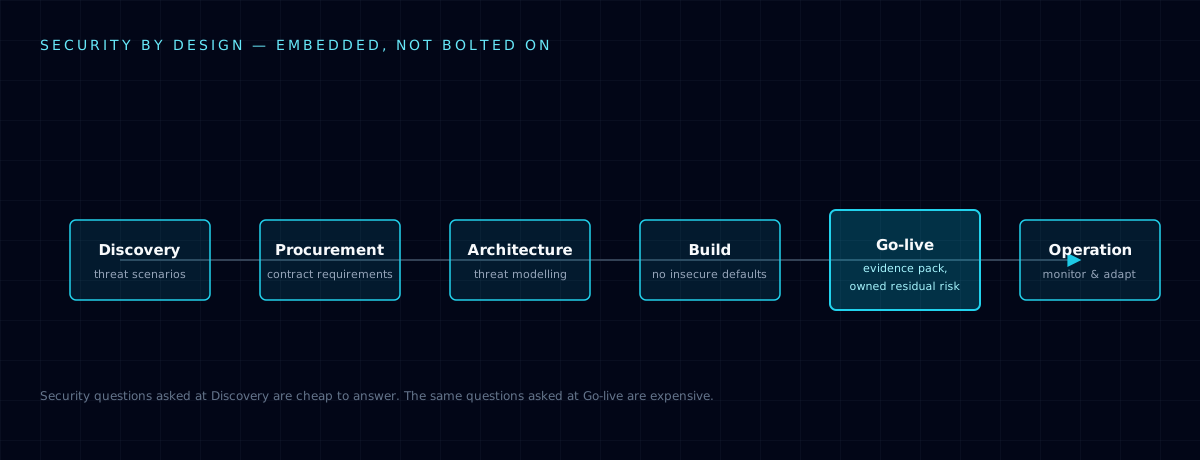
The cost of a security decision rises the later it's made. Ask the same questions at Discovery that you'd otherwise ask at Go-live, and they become design choices instead of last-minute exceptions.
What is Security by Design?
Security by Design means considering security objectives, threats and controls from the beginning of a product or service lifecycle. It is not a separate workstream added to a finished design. It is part of how the design is created.
The approach asks practical questions early:
- What information will the service process?
- Who will access it and from where?
- Which systems and suppliers will it trust?
- How could it fail or be misused?
- What evidence will be needed before launch?
- Who will own the service and its risks in operation?
Answering these questions early gives delivery teams choices. Answering them immediately before go-live usually produces exceptions, delays or expensive redesign.
The cost of involving security too late
Late security engagement concentrates risk at the worst possible moment. Commercial commitments have been made, technical dependencies are fixed and business stakeholders are expecting a launch.
Common consequences include:
- authentication models that do not meet organisational standards;
- incomplete logging or security monitoring;
- unclear data residency and retention arrangements;
- untested internet-facing interfaces;
- unsupported or unmanaged components;
- supplier responsibilities missing from contracts;
- high-risk findings discovered immediately before launch; and
- residual risk accepted under deadline pressure.
The problem is not that security raised concerns. The problem is that the project allowed important questions to remain unanswered until the cost of acting became high.
Embed security throughout the lifecycle
Discovery
Define the business objective, data sensitivity, criticality, users and likely threat scenarios. Use these factors to determine the depth of security activity required.
Procurement
Include security requirements in requests for proposal, evaluation criteria and contracts. Clarify responsibility for vulnerability management, penetration testing, incident notification, subcontractors, data return and secure deletion.
Architecture and design
Review identity, access, trust boundaries, integrations, encryption, logging, resilience and administrative access. A simple threat-modelling exercise can expose assumptions before they become embedded.
Build and configuration
Translate requirements into implemented controls. Record deviations and verify that security-sensitive settings have not been left at insecure defaults.
Testing
Test the service in a representative scope. Vulnerability scanning, penetration testing, configuration review and recovery exercises each answer different questions; no single activity proves that a system is secure.
Go-live
Make the decision from a clear evidence pack: implemented controls, unresolved findings, compensating measures, owners, deadlines and residual risk. Avoid turning approval into a vague statement that "security has signed it off."
Operation
Monitor changes, incidents, vulnerabilities, supplier performance and access. Security by Design includes designing how the service will remain secure — not merely how it will launch.
Make security requirements testable
A requirement such as "the supplier must use appropriate security" is difficult to verify. Better requirements describe an expected outcome and the evidence that will demonstrate it.
For example:
- privileged access must use multifactor authentication;
- administrative activity must be logged and retained;
- critical vulnerabilities must be remediated within an agreed timeframe;
- material incidents must be reported within a defined period; and
- independent testing must cover the production-facing attack surface.
Testable requirements reduce ambiguity and make assurance faster because everyone understands what "good" looks like.
Apply proportionality
Security by Design does not mean applying the maximum level of control to every initiative. It means making conscious, risk-based decisions.
A public information site, an internal collaboration tool and a safety-related operational service have different consequences and should follow different assurance routes. Proportionality protects high-risk systems without making low-risk delivery unnecessarily difficult.
A useful triage considers:
- confidentiality, integrity and availability impact;
- privileged or external access;
- internet exposure;
- regulatory obligations;
- dependency on third parties;
- operational or safety consequences; and
- novelty or uncertainty in the design.
Security patterns accelerate delivery
Organisations can make secure delivery easier by publishing reusable patterns for common scenarios. Examples include approved identity architectures, logging standards, supplier clauses, cloud landing zones and secure integration methods.
Patterns reduce repeated debate and give teams a known path. Exceptions are still possible, but they become conscious departures that require evidence and ownership.
Practical questions for project leaders
Before committing to go-live, ask:
- Was security involved before the design and contract were fixed?
- Are the most important risks documented and owned?
- Can the team demonstrate that key controls are operating?
- Does security testing reflect the real service and its interfaces?
- Are unresolved findings visible to the decision-maker?
- Is there a funded plan for remediation and ongoing operation?
- Would the decision remain defensible after an incident?
Final thoughts
Security by Design is not about adding more gates. It is about making better decisions earlier.
When security is integrated into delivery, teams avoid surprises, suppliers receive clearer expectations and leaders gain a more reliable basis for accepting risk. The result is not perfect security; it is a service whose risks were considered deliberately and whose controls can be demonstrated.
The best security approval is rarely the one delivered fastest at the end. It is the one made routine because security was present from the beginning.