Cyber Assurance: How to Enable Delivery Without Compromising Security
How delivery teams use cyber assurance to verify security controls, quantify residual risk and keep delivery moving without becoming a late-stage blocker.
Cybersecurity teams are often portrayed as the people who slow projects down. They ask difficult questions, request evidence and challenge decisions just as delivery deadlines begin to tighten. Yet this is not what good Cyber Assurance should look like.
Effective Cyber Assurance does not exist to prevent change. Its purpose is to help an organisation change safely, make informed decisions and demonstrate that important risks are being managed. When it is proportionate, evidence-led and integrated into delivery, assurance becomes an enabler rather than an obstacle.
This article explains what Cyber Assurance means, how it differs from governance and operations, why traditional approaches often create friction, and how organisations can build an assurance model that supports secure delivery.
Key takeaway
Assurance that engages at discovery costs less, moves faster and produces better decisions than assurance bolted on immediately before go-live. The fix is proportionate, evidence-led review built into the delivery lifecycle — not more paperwork at the end.
What is Cyber Assurance?
Cyber Assurance is the structured process of obtaining confidence that cyber risks are understood and that the controls used to manage them are appropriately designed, implemented and operating effectively.
The important word is confidence. A policy may state that an organisation uses multifactor authentication, reviews privileged access or assesses its suppliers. Assurance asks whether those activities really happen, whether they address the relevant risk and whether reliable evidence supports that conclusion.
Cyber Assurance can include:
- reviewing security architectures and designs;
- assessing suppliers and cloud services;
- validating technical configurations;
- examining vulnerability and penetration-test results;
- checking that risks have appropriate owners;
- testing incident response arrangements;
- reviewing control evidence and performance metrics;
- confirming that remediation actions have been completed; and
- reporting residual risk to accountable decision-makers.
It is therefore broader than compliance. Compliance asks whether a stated requirement has been met. Cyber Assurance also asks whether the requirement is suitable, whether the control is effective and whether the remaining risk is acceptable.
Assurance is not the same as cybersecurity operations
Cybersecurity operations and Cyber Assurance are closely connected, but they serve different purposes.
Operational teams implement and run controls. They configure security tools, manage identities, investigate alerts, patch systems and respond to incidents. Assurance evaluates whether those controls are sufficient and effective, and whether the organisation can prove it.
A useful distinction is:
- Governance sets direction, accountability and risk appetite.
- Operations implement and operate security controls.
- Cyber Assurance independently evaluates whether the controls adequately manage risk.
- Audit provides a further level of independent validation against defined criteria.
These functions should reinforce one another. Assurance should not duplicate operational work, and operations should not be expected to mark their own homework. Clear responsibilities reduce both control gaps and unnecessary process.
Why assurance becomes a delivery blocker
Assurance usually creates friction when it begins too late or operates without a clear view of risk.
A project may spend months selecting a supplier, designing a solution and agreeing a launch date before involving the security team. Assurance is then expected to provide immediate approval, despite incomplete documentation, unresolved vulnerabilities or uncertainty about how sensitive information will be protected.
At that point, every available option is unattractive. Delaying the launch affects delivery, accepting the risk weakens accountability, and introducing controls at short notice increases cost.
Other common causes of friction include:
- applying the same assessment to every system regardless of risk;
- requesting evidence without explaining why it is needed;
- relying on long questionnaires that do not reflect the actual service;
- treating certifications as automatic proof of security;
- failing to define who can accept residual risk;
- recording findings without tracking remediation; and
- repeatedly assessing the same supplier or control without reusing valid evidence.
These are signs of an inefficient assurance model — not evidence that assurance itself is unnecessary.
Begin with risk, not a checklist
A strong Cyber Assurance process starts by understanding the decision being made and the potential consequences if something goes wrong.
The initial questions should be straightforward:
- What service, system or change is being introduced?
- What information or business process will it support?
- Who will use, manage and support it?
- What could happen if its confidentiality, integrity or availability were compromised?
- Which security boundaries, suppliers and dependencies are involved?
- What decision must assurance support?
The answers determine the depth of review. A low-risk service handling public information should not receive the same level of scrutiny as a privileged platform, an important operational system or a service processing sensitive data.
This is the principle of proportionality: assurance effort should increase with risk, complexity and uncertainty.
Build assurance into the delivery lifecycle
The most effective time to influence security is before important design and contractual decisions become difficult to change.
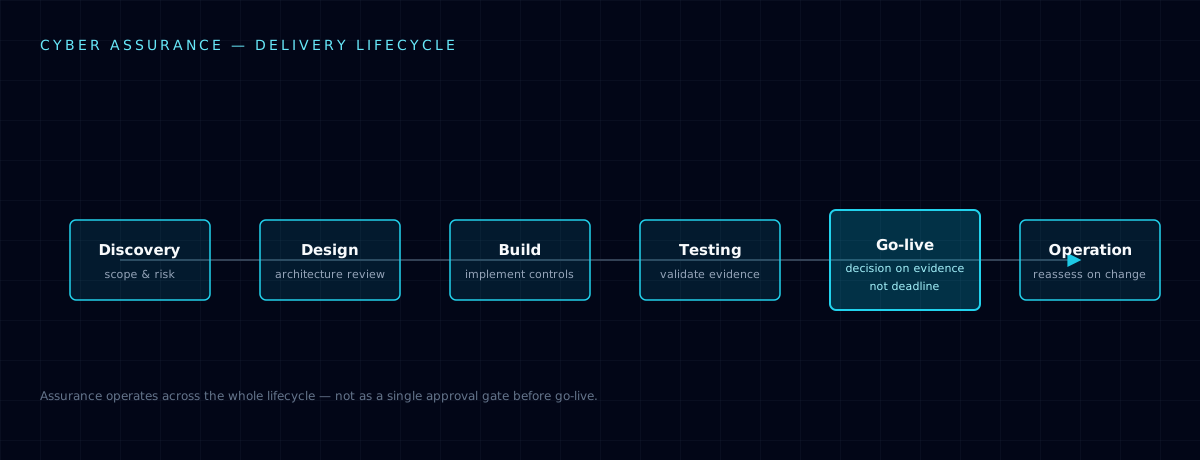
Cyber Assurance should therefore operate throughout the delivery lifecycle:
Discovery
Identify the business objective, data classification, criticality, users, suppliers and major dependencies. Establish the likely assurance route and required evidence early.
Design
Review the proposed architecture, trust boundaries, identity model, logging, resilience and support arrangements. Security requirements should become part of the design rather than late additions.
Build and implementation
Confirm that agreed controls are being implemented. Track deviations, emerging risks and supplier commitments while there is still time to address them.
Testing
Validate important controls through configuration reviews, vulnerability assessments, penetration testing, recovery exercises or other suitable methods. Testing should reflect the real scope of the service, including exposed interfaces and supporting applications.
Go-live
Present decision-makers with a clear view of completed controls, outstanding findings, compensating measures and residual risk. Approval should be based on evidence rather than optimism or deadline pressure.
Operation and change
Assurance does not end at launch. Material changes, new integrations, security incidents, expired certifications and overdue remediation may all trigger reassessment.
This lifecycle approach reduces surprises and makes security work part of normal delivery.
Use an evidence-led assurance model
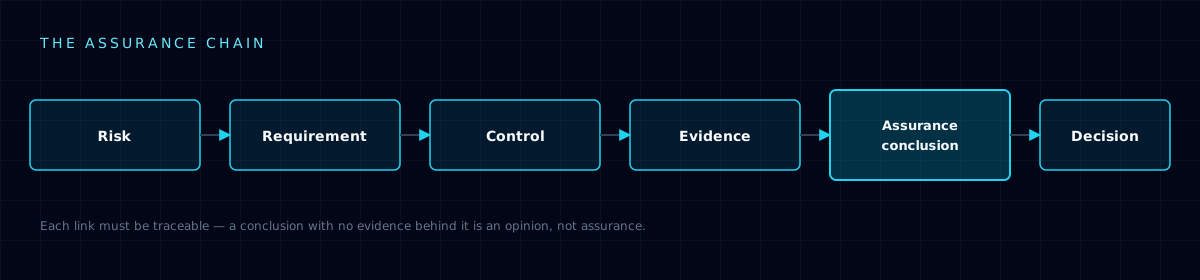
Cyber Assurance is only credible when conclusions can be traced to reliable evidence.
Evidence might include architecture diagrams, configuration exports, test reports, access reviews, incident records, recovery-test results, certifications, audit findings and security metrics. The appropriate evidence depends on the risk and the control being assessed.
A useful assurance chain is:
Risk → Requirement → Control → Evidence → Assurance conclusion → Decision
For example, if the risk is unauthorised access to sensitive information, the requirement might be strong authentication and least-privilege access. The controls could include multifactor authentication, role-based permissions and periodic access reviews. Assurance then examines evidence that these controls exist and operate as intended before reporting a conclusion.
This traceability makes decisions easier to explain, review and audit. It also prevents teams from gathering documents that do not meaningfully demonstrate security.
Make residual risk visible and owned
No system is entirely free of cyber risk. The purpose of assurance is not to promise perfect security; it is to provide a reliable basis for deciding what to do next.
A useful assurance outcome should state:
- the risk being considered;
- the controls already in place;
- any gaps or uncertainties;
- the likely business impact;
- required remediation and target dates;
- any temporary or compensating controls;
- the residual risk after treatment; and
- the person authorised to accept that risk.
This creates accountability. Cybersecurity specialists can advise, challenge and recommend, but a business risk should ultimately be owned by an appropriate business decision-maker.
Approval also does not need to be binary. Depending on the circumstances, an organisation might approve, approve with conditions, limit the scope, require remediation before launch or reject the proposal. Conditional approval can support delivery while preserving clear boundaries and deadlines.
Measure outcomes, not paperwork
An assurance programme should be judged by the quality of the decisions and risk reduction it produces — not by the number of questionnaires completed.
Useful measures may include:
- percentage of projects engaging assurance during discovery or design;
- time taken to triage and assess requests by risk level;
- number and age of overdue high-risk findings;
- percentage of conditional approvals completed by their deadlines;
- proportion of critical controls supported by current evidence;
- recurrence of previously identified issues;
- supplier reassessments completed on schedule; and
- trends in residual risk and formally accepted exceptions.
Metrics should identify where intervention is needed. A growing backlog may indicate insufficient resources, but it may also reveal an overly complicated process, unclear ownership or poor-quality requests entering the assurance function.
Principles of effective assurance
An effective model can be built around several enduring principles:
- Engage early. Assurance is most valuable while decisions can still be influenced.
- Be proportionate. Match the depth of review to risk, complexity and uncertainty.
- Explain the purpose. Every evidence request should support a risk or control decision.
- Reuse trustworthy evidence. Do not repeatedly ask for information that remains valid.
- Maintain independence. The people evaluating a control should have sufficient separation from those implementing it.
- Record decisions. Findings, conditions, exceptions and risk acceptance should be traceable.
- Track remediation. An assurance report has little value if agreed actions disappear after approval.
- Review material change. Assurance should respond to changes in technology, suppliers, threats and business use.
- Communicate in business language. Describe consequences and choices, not only technical weaknesses.
- Enable informed risk-taking. The objective is secure delivery, not the elimination of all risk.
A practical assurance operating model
Organisations do not need to create a large bureaucracy to improve assurance. A practical starting model can be relatively simple:
- establish a single route for submitting assurance requests;
- use initial triage to determine risk and required review depth;
- publish clear minimum evidence requirements for common scenarios;
- assign accountable owners for risks and remediation;
- maintain a central record of decisions and exceptions;
- define escalation thresholds for significant residual risk;
- introduce scheduled reviews for critical services and suppliers; and
- report trends to governance forums in a concise, decision-focused format.
As the organisation matures, it can develop reusable control patterns, automate evidence collection and align assurance activities with frameworks such as ISO/IEC 27001, the NIST Cybersecurity Framework or the NCSC Cyber Assessment Framework. Frameworks should provide structure, but the organisation's risks and operating context must continue to drive decisions.
Final thoughts
Cyber Assurance is sometimes mistaken for a final security checkpoint. In reality, it is a continuous process for building confidence, exposing uncertainty and helping accountable leaders make defensible decisions.
Done badly, it creates paperwork, delay and adversarial relationships. Done well, it identifies problems earlier, improves accountability and gives delivery teams a clearer route to approval.
The goal is not to remove every cyber risk. It is to ensure that important risks are understood, appropriate controls are working and the organisation can demonstrate why its decisions are reasonable.
That is how Cyber Assurance becomes an enabler of secure delivery rather than a barrier to progress.